Finishing is Available for ALL Products, including those where the finishing options are not shown yet! We offer a wide selection of finishes, including kitchen and bath cabinets, bookcases, and furniture! If you see a piece of furniture without a listed finishing option, contact us.
All Woodcraft kitchen cabinets, bookcases, and furniture are available unfinished or in a choice of 14 stain colors, 9 paint colors, and 3 specialty finishes with a glaze, and a Natural clearcoat varnish. A Brown or Black glaze can also be added to any stain or paint color for an extra 10%. The specialty finishes are made as follows:
Woodcraft and Arthur Brown products use the Becker Acroma Finishing System (www.becker-acroma.com), which is a high-quality, durable, and environmentally friendly professional-grade post-catalyzed conversion varnish. The paint is called Becker-Acroma Matador. This results in a non-yellowing, catalyzed conversion varnish that emits very low VOCs (Volatile Organic Compounds). The conversion varnish high-build properties produce a durable, chemical-resistant finish. The Becker-Acroma Matador paint can be color matched to any Benjamin Moore or Sherwin Williams paint color.
Conversion varnish, also called catalyzed conversion varnish or catalyzed varnish, is a lacquer that consists of a high-end solid two-part post-catalyzed application process. In short, a hardening agent is added to the varnish prior to painting, which provides additional durability when combined with the heat-curing process. Conversion varnish is chemically cured and fast-drying and consists of 40-60% solids. However, it must be applied by a professional to ensure the correct ratio of chemicals and solids is used so that it hardens correctly. A varnish wood finish does cost more than house lacquer, but it is also much more durable and easier to clean. It is this characteristic that makes it an excellent option for painted cabinet doors.
Polyurethane is often considered one of the most durable finishes, so many people weigh conversion varnish vs. polyurethane when replacing cabinet doors. Polyurethane can have many benefits, particularly when compared to many other finishes. Polyurethane is actually a form of varnish and is quite durable. Polyurethane can resist scratching, heat, alkali, and acids and wear better than many other finishes, including lacquer. It also offers an attractive, protective finish. However, on the downside, polyurethane can yellow over time, especially if in direct sunlight. It also requires sanding in between each coat to ensure proper bonding, and since the dry time is up to 24 hours, it takes quite some time to fully finish a piece. It is also typically brushed on rather than sprayed on, slowing the application even more. Conversion varnish is typically more costly than polyurethane because it needs to be professionally applied. However, it also lasts much longer and is still consistently more durable. While a varnish wood finish might cost a little more, it is ultimately a better value, offering longer-lasting protection and durability.
A varnish wood finish is a premium option for all sorts of projects, including cabinetry and cabinet doors. This post-catalyzed conversion varnish offers a number of benefits, especially compared to other cabinet paint or lacquer products. Let’s take a closer look at the advantages offered by conversion varnish to better understand why it’s such a smart choice.
Maple is usually the best choice of wood for painting since it has the least amount of grain. The heavy grain in Oak can sometimes be seen, especially with light colored paints.
No. Please note that the bottom "toe kick" area of kitchen and vanity cabinets are not made of stain-grade material. When placing multiple cabinets together, there will also be a 1/2" gap between the toekick area of adjacent cabinets, which means that you must use a long piece to span multiple cabinets. For the best appearance, please order matching "toe kick" material or base moulding that is no more than 4.5"H (the toe kick area is 4.5"H x 3"D).
To get a sample of the finish colors, please visit our sample request page and see below for the color choices.
If you want a completely custom look to your furniture, but are not up to the task of finishing them yourself, consider having an experienced finisher finish them for you according to your tastes. You can find someone near you by doing a web search for "furniture refinishers" and your city name.
Below are some examples of faux finishes applied to wood furniture and cabinets.
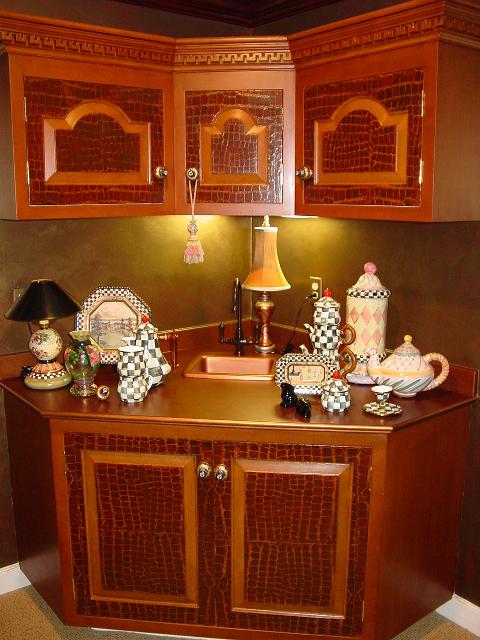
Above: This photo is of a set of cabinets with a faux alligator-skin pattern. The photo makes it look more reddish than it really is in person.
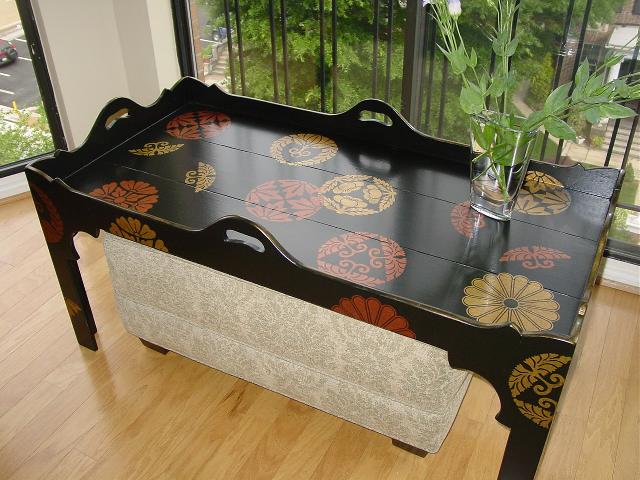
Above: This photo is of a table with a black lacquer finish and several stencil patterns.
